- Solutions
ENTERPRISE SOLUTIONS
Infuse new product development with real-time intelligenceEnable the continuous optimization of direct materials sourcingOptimize quote responses to increase margins.DIGITAL CUSTOMER ENGAGEMENT
Drive your procurement strategy with predictive commodity forecasts.Gain visibility into design and sourcing activity on a global scale.Reach a worldwide network of electronics industry professionals.SOLUTIONS FOR
Smarter decisions start with a better BOMRethink your approach to strategic sourcingExecute powerful strategies faster than ever - Industries


Compare your last six months of component costs to market and contracted pricing.


- Platform
- Why Supplyframe
- Resources
Risk is a given when it comes to supply chains. The real question is “what risk should we focus on?” This is a question that supply chain professionals ask themselves every day, as the global landscape continues to shift.
Over the course of 2026, we have continued to monitor and examine the biggest risks facing industry professionals, and how teams can take a proactive, collaborative approach to mitigating them. Join us as we explore the top 3 risks affecting supply chains in 2026, how teams can address each one, and what industry experts are saying about this ever-shifting landscape.
1. Memory Chip Demand and Shortages
One of the most prevalent topics facing numerous industries in 2026 is how AI infrastructure and its associated demand is affecting the availability of memory and other types of components.
What was first seen as a temporary shift and evolved into a structural one. AI is here to stay, and that means teams need to get ahead of dwindling supply and rising prices. Right now, industry experts claim that current DRAM shortages, for example, could last until 2030.
Meanwhile, manufacturers are trying to use AI in their own sourcing and procurement efforts.
Situations like this are often cited as strong use cases for real-time, AI-driven intelligence.
Late last year, we sat down with David Gessler, VP of Procurement and Supply Chain Management at Flex, a global manufacturing leader in partnership with Supplyframe, to gather his thoughts on using AI to enhance decision-making
“Like every other company in the world right now, we’re trying to figure out how to better utilize AI in our processes, and that’s a journey,” David said, “The ability for AI to sort through both the cost and risk curves will enable companies like Flex to make more informed business decisions.”
He also pointed to the importance of strengthening underlying processes and tools. “Passing spreadsheets, although everybody does it and it’s efficient, you lose rev control, everything’s out of date, and you’re always looking for an update. So, the ability to have collaborative and digital tools that everybody can access as a single source of truth definitely provides value.”
Market Dynamics Forecast: Memory
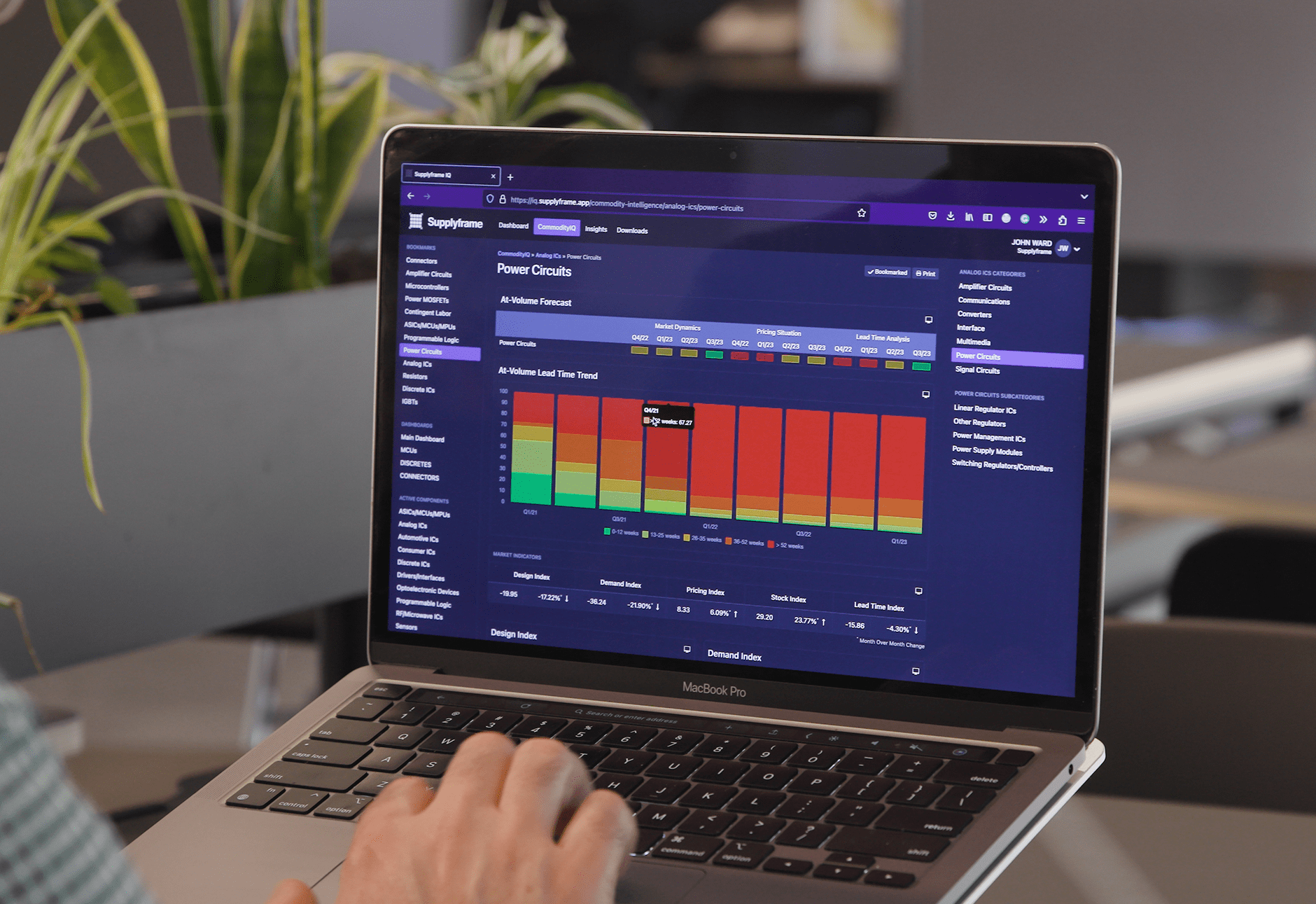
And speaking of intelligence, if we look at the current Market Dynamics Forecast for memory in Supplyframe’s Commodity IQ intelligence dashboard, the heat map paints a dire picture across demand, lead times, and pricing for every quarter leading into Q1 2027.
This includes DDR3-DDR4 Modules, DDR4, DDR5, DRAM, HBM, LP DDR1-DDR4, all of which are in the red. The Commodity IQ Demand Index, which measures overall demand across our global DSI Network, is showing a 70% increase quarter-on-quarter. Meanwhile, lead times are up 25% in the same time period, and pricing is up 57% as well.
The story here isn’t very nuanced: memory is currently one of the most constrained environments across all memory types as of Q2 2026. To learn more about the memory situation, read this article on the Findchips Blog.
Here are some of the latest developments and recommend actions:
- The Situation: For HBM, DDR5, DDR4, and NAND, extended lead times are nothing new. What is new is that the shortage is expanding. NOR is showing shortage signals, with pricing per rack in NVIDIA’s GB200 NVL72 AI server exceeding $600. This is catching many buyers off-guard.
- Recommended Action: Teams should audit BOMs for any memory type (including NOR), and verify supply coverage. Don’t assume that any parts, which are historically easy to source, are still available.
- For Procurement and Supply Chain Teams: Treat memory as a tier-1 risk. Escalate visibility to the executive level. Do not rely on distributor spot inventory. Establish direct supplier relationships based on allocation agreements
2. Geopolitical Instability
Geopolitical tensions and instability have always been a factor in supply chain risk, but in 2026, these things have become a structural condition as opposed to a temporary disruption. At this point, there are several major ongoing situations to monitor:
- U.S.-China technology restrictions/sanctions – These developments create a ripple effect across supply chains by limiting access to advanced semiconductors, equipment, software, and materials.
- Taiwan risk – Any shifts in Taiwan’s stability will be felt as well, given that this is the center of advanced semiconductor manufacturing and leading edge/AI chips.
- Red Sea and Strait of Hormuz instability – Instability in this region leads to global shipping disruption and rising cost. The result is higher transportation expenses, and uncertainty for procurement and supply chain teams managing just-in-time production.
- Export controls – Changes in this landscape create supply uncertainty by limiting access to certain products or components, leading to redesigns and longer qualification cycles.
- Reshoring and nearshoring mandates – These efforts can create short-term costs due to investments, labor differences, supplier qualification, and duplicated infrastructure. However, the long term trade-offs here are greater supply chain stability and risk
The Iran War is putting pressure on PCB manufacturers specifically, as key supply shortages continue to emerge in terms of raw materials. Whether it’s helium needed for semiconductor manufacturing, aluminum for automotive, or in the case of PCBs: critical minerals and resins.
Market Dynamics Forecast: Printed Circuit Boards
Supplyframe’s real-time intelligence solution, Commodity IQ, paints a clear picture of how things may look for the rest of 2026 in this regard. The Market Dynamics Forecast for printed circuit boards shows rising demand heading into Q1 2027, specifically an uptick in Q1.
Meanwhile, lead times are currently elevated, with the forecast showing some relief heading into Q1 2027. Pricing, however, is where things will be difficult, thanks to the recent disruption. The reality is that this metric will likely remain inflexible throughout 2026, with potential (modest) relief in Q1 2027.
Here is our recommendation for the situation here:
- For Manufacturers: Now is the time to audit your laminate supplier base. If you source PPE-based laminates from Saudi-linked supply chains, you may already be looking at allocation constraints. Qualification of alternate resin suppliers should take priority.
- For Buyers: Expect lead time extension notifications on advanced boards in the near-term. The situation here is a combination of supply-driven disruption and demand-driven capacity tightness. In other words, compounding risk.
3. The Shift Toward Adaptability
For decades, global supply chains were optimized for maximum efficiency: lean inventories, single-source suppliers, tightly synchronized logistics, and just-in-time delivery models designed to remove every ounce of excess cost.
That model worked in relatively stable markets, but today’s environment has exposed how fragile hyper-optimized supply chains can become. Companies are realizing that operating “one disruption away” from failure is no longer sustainable.
The shift now is from lean to resilient, and increasingly, from resilience to adaptability. Resilience focuses on absorbing shocks; adaptability focuses on responding dynamically as conditions change.
That means organizations are intentionally building more flexibility into their supply chains through dual sourcing, regional manufacturing diversification, strategic inventory buffers, and broader supplier qualification.
Here are our recommended actions:
- Diversify critical suppliers and regions
Reduce dependency on single suppliers, countries, or logistics corridors by qualifying secondary and tertiary sources across multiple geographies. - Segment components by risk, not just spend
Prioritize monitoring and mitigation for components with long lead times, geopolitical exposure, limited manufacturing capacity, or high redesign complexity. - Build strategic inventory buffers
Move beyond strict just-in-time models for high-risk components by maintaining targeted safety stock for critical programs and revenue-sensitive products. - Increase supplier visibility beyond Tier 1
Understand upstream dependencies including wafer fabs, substrate suppliers, raw materials, and outsourced assembly/test providers to identify hidden concentration risks. - Shorten response cycles with market intelligence
Use real-time pricing, availability, and lead-time signals to detect supply shifts early and make faster sourcing decisions before disruptions escalate. - Collaborate earlier with engineering teams
Align procurement and design teams on component standardization, lifecycle planning, and alternate part qualification to improve flexibility during shortages.
The Bottom Line: Real-Time Intelligence is a Must
There are far more risks to consider than the three mentioned above, but these give a broad scope of how much uncertainty exists across the global electronics value chain in 2026. Teams can no longer survive, let alone thrive, without insights and intelligence to guide them forward.
Supplyframe’s Commodity IQ solution offers a real-time glimpse into the latest insights across all major electronics commodities, and over 250 sub-commodities as well.
To learn more and download a free sample summary, visit Supplyframe.com today.