- Solutions
ENTERPRISE SOLUTIONS
Infuse new product development with real-time intelligenceEnable the continuous optimization of direct materials sourcingOptimize quote responses to increase margins.DIGITAL CUSTOMER ENGAGEMENT
Drive your procurement strategy with predictive commodity forecasts.Gain visibility into design and sourcing activity on a global scale.Reach a worldwide network of electronics industry professionals.SOLUTIONS FOR
Smarter decisions start with a better BOMRethink your approach to strategic sourcingExecute powerful strategies faster than ever - Industries


Compare your last six months of component costs to market and contracted pricing.


- Platform
- Why Supplyframe
- Resources
When it comes to predicting the future of AI demand in electronic components, many are looking to the companies that have the largest stake in the technology. Their moves could act as a barometer for how the rest of the industry will follow.
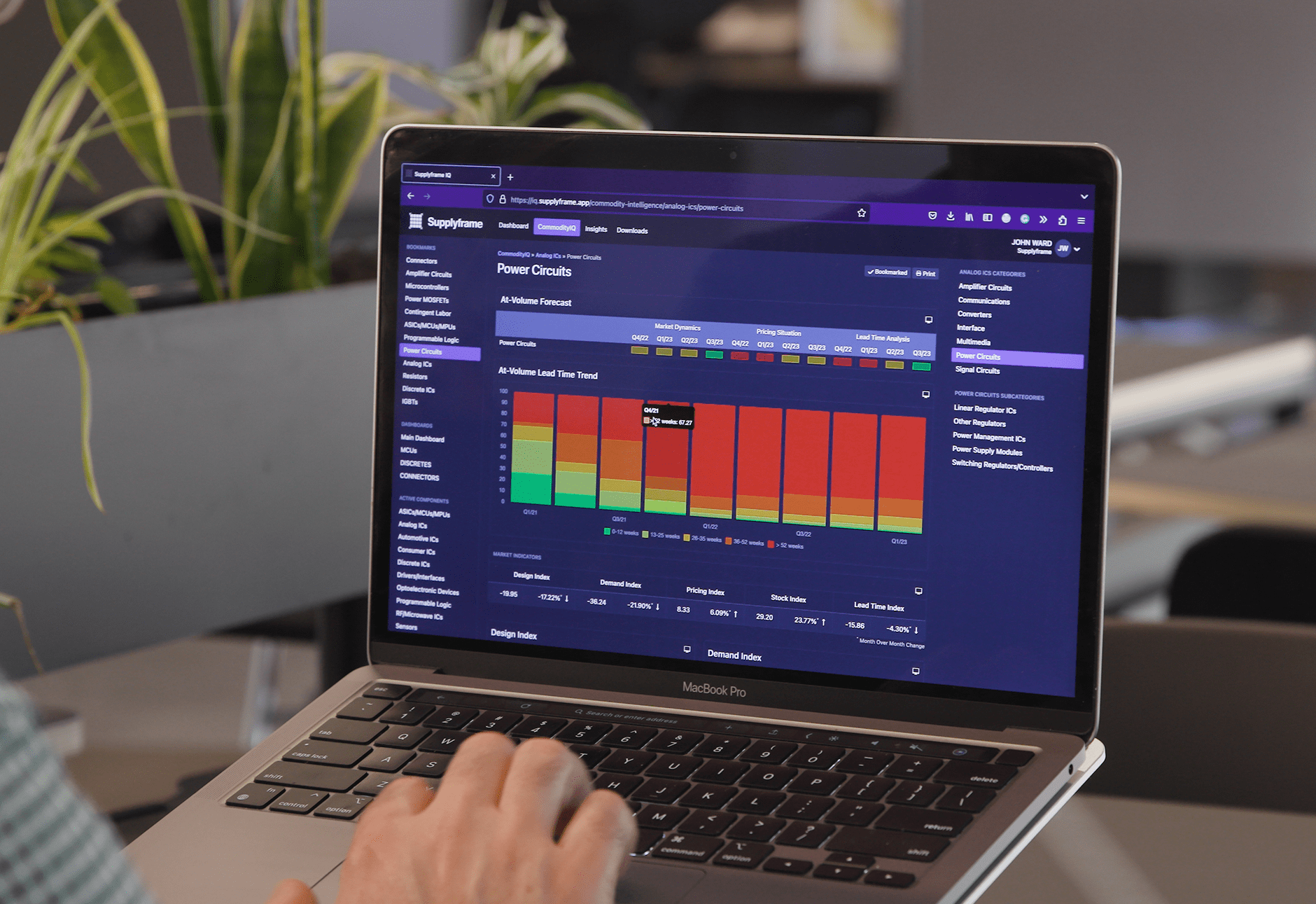
At Supplyframe, we also monitor billions of real-time data signals across our global DSI Network, which enables deep insights into electronics commodities and their inherent shifts due to AI-based demand. Combining these two perspectives, it’s time to ask: where is AI demand heading in 2026 and beyond, and what should engineers do about it on the design side?
What the Major Industry Players are Saying & Doing
TSMC’s last earnings report projected capital expenditures between $52 billion and $56 billion in 2026, well above the $44 billion that was expected. Spending like this is not unique to the AI industry, but the difference here is that excess data centers can eventually be utilized.
The chip industry is cyclical in nature. Heightened AI demand won’t last forever, but that’s why TSMC’s investments are a valid (and early) indicator of how and when these trends may shift. So, what are these actions telling us at a high level?
In short, the market isn’t behaving like this is a short inventory correction. Instead, TSMC is making multi-year, capital-intensive commitments to fabs, packaging, suppliers, and so on. TSMC says that cloud providers are giving “very strong signals” that this multi-year AI megatrend will continue.
Now the question becomes “how do we scale the entire AI system supply chain?” And, the answer here is not simple. Pressure points include advanced packaging, HBM, substrates, power, thermal, high-speed interconnects, and analog components.
Right now, buyers need to take care that they don’t misread a structural demand curve as a temporary spike. This isn’t going anywhere anytime soon.
Drilling Down to the Component Level: What Commodity IQ is Showing Right Now
AI demand is affecting multiple electronics commodities. We have heard plenty about the effects on memory, and specifically, DRAM, but here are the other categories that have felt the pressure of AI in 2026 thus far:
- Memory – Including HBM and DRAM for AI accelerators
- Programmable Logic – FPGAs are used in AI workloads
- Sensors – Used in AI-enabled edge devices
- Storage – NVMe/SSD demand is driven by AI data center needs
- Optoelectronic Devices – Optical interconnects are used in AI data centers as well
- ASICs/MCUs/MPUs – for AI chips and inference processors
Memory: The Most Distorted Market in Our Database
Let’s start with memory. In this case, Supplyframe Commodity IQ shows that demand, lead times, and pricing are all experiencing increases and constraints respectively. DRAM shortages in particular are expecting to result in a 58-63% increase in contract prices for Q2 2026. Here is what we’re seeing in Supplyframe Commodity IQ:
- Demand Index: 32.24, up 30.74% month-over-month
- Lead Time Index: 9.91, up 5.45%
- Pricing Index: 157.43, up 31.21% (the highest of any major semiconductor category)
Looking across the sub-commodity forecast grid, HBM, DDR3, DDR4, DDR5, and LP DDR are red across all four quarters from Q2/26 through Q1/27 for demand, lead times, and pricing simultaneously. EEPROM remains the lone green outlier with oversupply and stable demand. NAND, NOR, and SRAM are mixed yellow.
Here’s what engineers should do:
- Treat any new design with DDR4, DDR5, or HBM as supply-constrained by default and qualify a second source at schematic-capture time, not at production. The CIQ lifecycle data says the part you specced last year may already be Transferred or Discontinued.
- For DRAM-bound designs, look at the actual top-trending parts in the CIQ Memory dashboard before committing. The most-researched DDR4 right now is Micron’s MT40A512M16TB-062E:R (8Gb DDR4-3200), and the top DDR3 is Micron’s MT41K256M16TW-107:P. Cross-checking those on Findchips against authorized vs. independent stock will tell you in 30 seconds whether your BOM is in the safe lane.
- For boot/config flash, Winbond’s W25Q128JVSIQ and W25Q64JVSSIQ dominate research traffic. They have wider distribution than equivalent Micron QSPI parts right now, which matters when authorized stock is razor-thin.
- If a design can tolerate it, EEPROM is the only memory sub-category in oversupply.
Programmable Logic: Calm Now, Dangerous in Q1 2027
CIQ’s April 2026 Programmable Logic snapshot looks deceptively benign on price but tells a darker forward story:
- Demand Index: 29.76, up 52.21% month-over-month. The largest sequential jump in the FPGA category in five years
- Lead Time Index: 21.19, up 17.71%
- Pricing Index: 1.41, up only 1.30%. Pricing is stable today
The forecast grid shows the warning. Both FPGAs and PLDs are green/stable through Q3/26 and Q4/26, then flip to red on demand AND pricing in Q1/27. April is expected to bring some moderation, but the structural setup says lead-time and price spikes are likely Q4/26 into Q1/27 as the buy cycle for next-gen AI accelerator companion logic accelerates.
The lifecycle view explains why this is so fragile: across 390,000 FPGA parts, 39.26% are Transferred, 30.64% Active, and 26.61% Discontinued.
Findchips confirms this. The top-trending FPGA in CIQ traffic is AMD’s Zynq-7020 XC7Z020-1CLG484I. a workhorse for AI edge inference and sensor-fusion designs.
What engineers should do:
- If your AI edge or sensor-fusion design is anchored on a Zynq-7000, Artix-7, or Cyclone V part, for example XC7A200T-2FBG676I or 5CEFA9F23I7N, buy your Q1/27 silicon now or qualify a Lattice LCMXO2-1200HC-4TG100C-class alternative for the glue-logic pieces.
- Where the FPGA is doing fixed-function AI acceleration, consider whether an ASSP or a fixed-function accelerator gets you out of the Q1/27 window entirely.
- Re-spin the BOM through CIQ’s lifecycle filter. If 65%+ of the FPGA catalog is Transferred or Discontinued, your “second source” from two years ago may not exist as an orderable part anymore.
Storage: Demand is Stable, but Supply Chains are on Fire
Storage is the cleanest example of an AI-driven structural shift. The CIQ April 2026 forecast grid shows demand sitting in yellow/stable territory across eMMC, microSD, PCIe/NVMe Client, PCIe/NVMe Enterprise, SAS Client, SAS Enterprise, SATA Client, SATA Enterprise, and SD Cards for all four quarters Q2/26 through Q1/27. There is no relief in the forecast.
What engineers should do:
- For any new storage-bound design, lock controller silicon and NAND allocation 9-12 months earlier than you used to. The lead time index is signaling that “place the order when you tape out” no longer works.
- Engineering teams designing edge or industrial gear should resist the reflex to spec the same enterprise NVMe SKU the data center team uses. Diversifying across PCIe/NVMe-Client and SATA-Enterprise can de-risk a multi-product BOM. Findchips’ PCIe NVMe SSD search is a fast way to compare authorized stock across form factors.
- Build a safety stock plan for cache DRAM. The storage shortage is partly being passed through DRAM-channel competition.
Optoelectronics: AKA, The AI Interconnect Bottleneck
CIQ’s Demand Analysis on Optoelectronics is the most explicit AI-tied commentary in the database right now. From the April 2026 demand brief:
- The Commodity IQ Demand Index for optoelectronics surged 29.7% sequentially in March 2026 to 81.5, after a 16.8% decline in February.
- The recovery is being driven specifically by AI data center expansion, high-speed optical networking upgrades, automotive electrification, and industrial automation.
- The forecast grid shows demand stable through Q4/26, then red across the board in Q1/27.
What engineers should do:
- If you’re designing 800G or 1.6T optical interconnect boards for AI racks, qualify two transceiver vendors per port speed before silicon tapeout. Use Findchips searches like QSFP-DD 800G and OSFP 800G to compare what is actually in distribution.
- For laser diodes and high-speed photodiodes inside transceiver designs, lock in second sources now while lead times are still in the manageable single-digit weeks for most authorized parts. If you wait until Q4/26 to qualify, you’ll be qualifying into a shortage.
- For automotive and industrial designs that use optoelectronics for sensing rather than data center interconnect. Lead times are forecast to improve, so this is the right time to refresh designs that have been carrying old, soon-to-be-EOL parts.
- Watch fiber optics specifically. Fiber Optics is broken out as a separate sub-category in CIQ and tracks differently from broader optoelectronics. If your design uses pluggable fiber modules, the Findchips fiber optic transceiver search is the fastest way to gauge real availability vs. catalog.
ASICs, MCUs, and MPUs: What Other Categories are Signaling
ASICs, MCUs, and MPUs are less dire, with demand, lead times, and pricing mixed across the board. That being said, prices are expected to increase in Q2 2026 for this category, as Intel has announced double-digit price hikes across its 10nm CPU line, and 10-15% server CPU prices hikes as well.
We did not pull representative parts for these in this issue because the supply pressure is not as acute, but they are worth watching, and CIQ’s dashboard view will surface the next category to flip.
Now, let’s take a look at what the future may hold for AI demand.
AI Demand in H2 2026 and Beyond
Let’s translate this demand into a different kind of number: revenue. Gartner forecasts that worldwide semiconductor revenue will exceed $1.3 trillion in 2026.This is a 60% increase from 2025, driven almost entirely by the AI infrastructure boom.
Based on the data above and other insights from Supplyframe Commodity IQ, we can extrapolate a few different possibilities and trends for industry leaders to watch:
- H1 2026 will most likely be stronger than the second half of the year. Seasonal peaks could arrive earlier than prior years, but with inventories at multi-year lows, even a demand plateau will still lead to supply constraints.
- Of the revenue listed above, AI-related semiconductors accounted for one-third of global chip revenue in 2025, and are expected to account for 50%+ of revenue by 2029. This indicates a structural shift, not a cyclical one.
- Demand continues to spill over into new commodities, as we’ve noted above.
- Geopolitical factors continue to add uncertainty. The helium supply disruption from Iran’s attacks on Qatar’s Ras Laffan facility introduces the potential for a supply shock in H2 2026 if disruption persists.
- While current forecasts show some moderation in Q1 2027, the lead time for new semiconductor capacity is still 2-3 years, which means that supply recovery most likely won’t occur before mid-2027 at the earliest.
Among all this uncertainty, one thing remains clear: organizations need forward-facing insights and reliable sources of intelligence to properly navigate the short and long-term effects of AI infrastructure rollout.
Supplyframe Commodity IQ offers customizable dashboards across all major electronics commodities, and over 250 sub-commodities as well. Real-time analysis of demand, pricing, lead times, and more gives teams the data they need to make better, more profitable decisions.
Visit Supplyframe.com today to learn more, and to download a sample summary.
Sources: Live Supplyframe Commodity IQ dashboards (Memory, Programmable Logic, Storage, Optoelectronic Devices), April 2026; Findchips price-and-stock pages for representative MPNs; TSMC Q1 2026 earnings call; Gartner semiconductor revenue forecast (Apr 8, 2026).