- Solutions
ENTERPRISE SOLUTIONS
Infuse new product development with real-time intelligenceEnable the continuous optimization of direct materials sourcingOptimize quote responses to increase margins.DIGITAL CUSTOMER ENGAGEMENT
Drive your procurement strategy with predictive commodity forecasts.Gain visibility into design and sourcing activity on a global scale.Reach a worldwide network of electronics industry professionals.SOLUTIONS FOR
Smarter decisions start with a better BOMRethink your approach to strategic sourcingExecute powerful strategies faster than ever - Industries


Compare your last six months of component costs to market and contracted pricing.


- Platform
- Why Supplyframe
- Resources
According to SK hynix chairman Chey Tae-won, the current memory shortages impacting the global electronics landscape could last for another four to five years. Speaking at NVIDIA’s GTC event in California in March, Chey outlined the reasons why this may be the case.
In 2026, it’s estimated that data centers will take up 70% of total high-end memory supply. As a result, this projection is quickly gaining traction as AI-driven memory demand shows no signs of slowing down. Join us as we explore the current state of the memory market, and what it means for sourcing and engineering professionals in the long-term.
The Issue is About More Than Just AI Demand and Spot Buys
Demand for memory spot buy purchases has seen exponential increases Quarter-over-quarter (a 70.56% increase according to Supplyframe Commodity IQ) due to AI infrastructure buildout. This is an extraordinary surge, reflecting a combination of AI infrastructure procurement and safety stocking behavior from OEMs.
The problems run deeper than just surging demand, however. All of these demand spikes are also influencing pricing. Current forecasts from Supplyframe Commodity IQ predict a 30-50% in DDR5 prices through mid-2026. HBM3e prices are also rising an additional 20% YoY as NVIDIA H200 and next-gen ASIC demand increases as well.
Overall, DDR DRAM spot buy activity is 44 times higher than normal levels. This is a result of DRAM manufacturers moving production to HBM to serve the growing AI demand, leading to further shortages.
The other side of the equation, of course, is the wafer intensity needed to build high-bandwidth memory (HBM) for accelerators and AI servers. HBM has quickly become one of the industry’s most profitable categories, which means that capacity is being allocated accordingly.
Why is this important? Because developments like this shift the broader discussion away from short-lived shortages and into structural memory constraints that could last for years. Companies like SK hynix and others are working to add capacity, but it’s going to take time.
Meanwhile, other companies like Samsung are pushing for longer supply agreements amidst rising DRAM and NAND costs. All of this points to an issue that will be with for much longer than a few quarters.
For example, new fabs have lead times of between 3 and 5 years before they can contribute to supply. The other issue, of course, is that AI demand is not linear. Instead, it’s compounding. Finally, memory suppliers are prioritizing HBM over DRAM and trying to avoid oversupply mistakes from past shortages.
DRAM ASP pricing is 13 times higher than it was in 2020, further illustrating thr need for teams to mitigate pricing risk and to choose carefully when sourcing.
Taken together, it’s a perfect storm that results in less supply for non-AI applications even if the total capacity grows.
What Sourcing and Procurement Teams can Do
For sourcing and procurement teams, the first order of business should be to reduce uncertainty and improve decision confidence. Here’s what that looks like in practice:
- For Procurement:
- Pivot to allocation-only ordering and reject standard discretionary orders.
- Secure non-cancelable, non-returnable (NCNR) contracts for baseline needs
- Renegotiate customer agreements to include variable pricing clauses
- Explore authorized independent distributors (ensure they have AS6081/AS6496 accreditation to avoid counterfeits)
- For Engineering:
- Design for flexibility (avoid single-source where possible)
- Pre-quality alternates and lower-bandwidth fallbacks
- Reduce dependence on top-tier HBM where possible
- Involve procurement right away and at design for future products
These steps are crucial, and the sooner they are integrated into overall sourcing strategies, the better. In the meantime, it’s also important to empower commodity managers with detailed, real-time analysis across the memory market.
Enabling Smarter Sourcing Decisions
Supplyframe’s Design-to-Source Intelligence (DSI) Network spans over 12 million engineering and sourcing professionals around the globe. Their daily activity across over 70 web properties provides billions of data points into real-time supply, demand, inventory, and pricing.
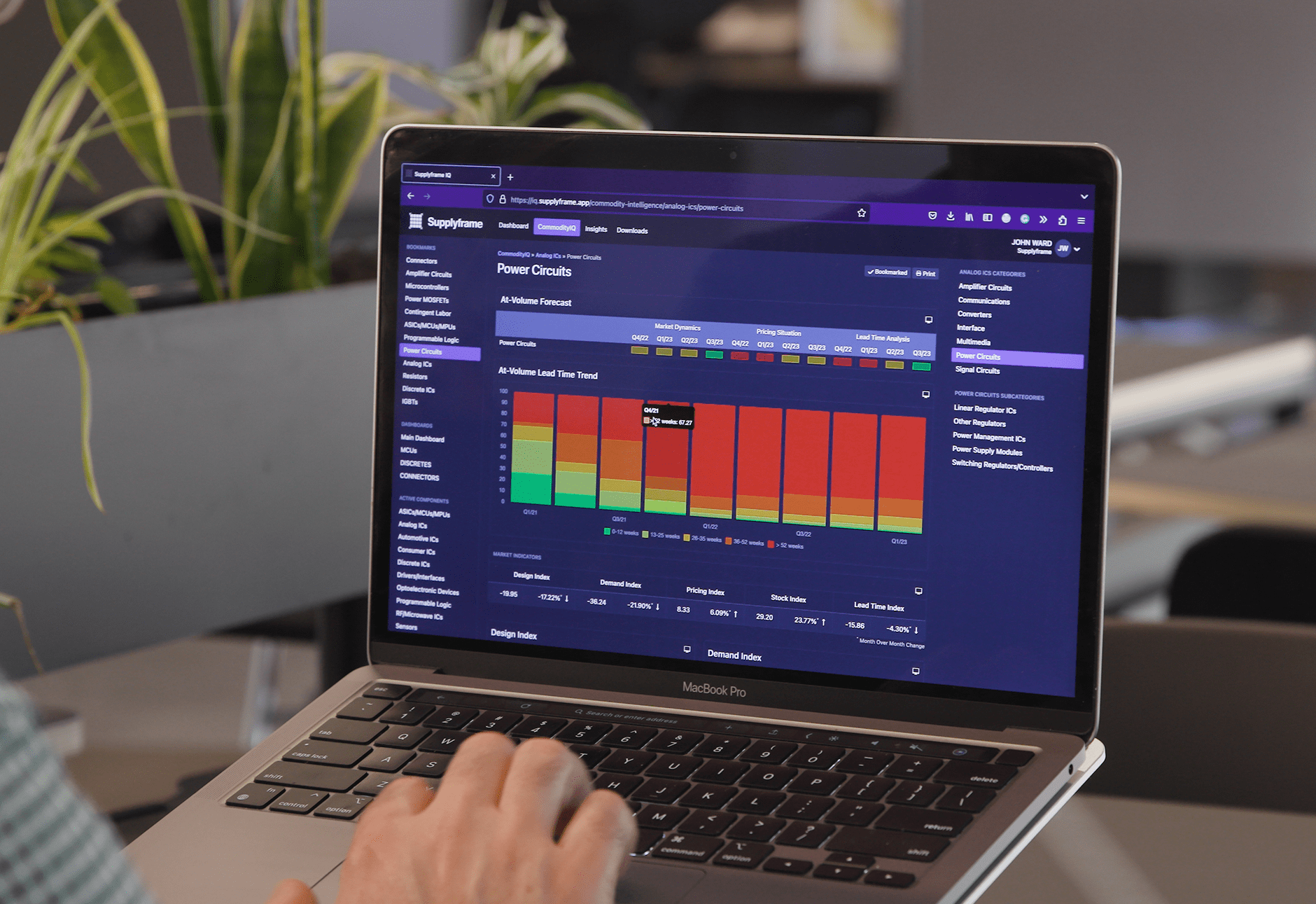
Supplyframe Commodity IQ leverages this vast network to provide a wholly unique view of operational insights and analysis into over 240 commodities and sub-commodities that you won’t find anywhere else.
Learn more about Commodity IQ, and download a free sample summary today to see Supplyframe’s intelligence in action.